
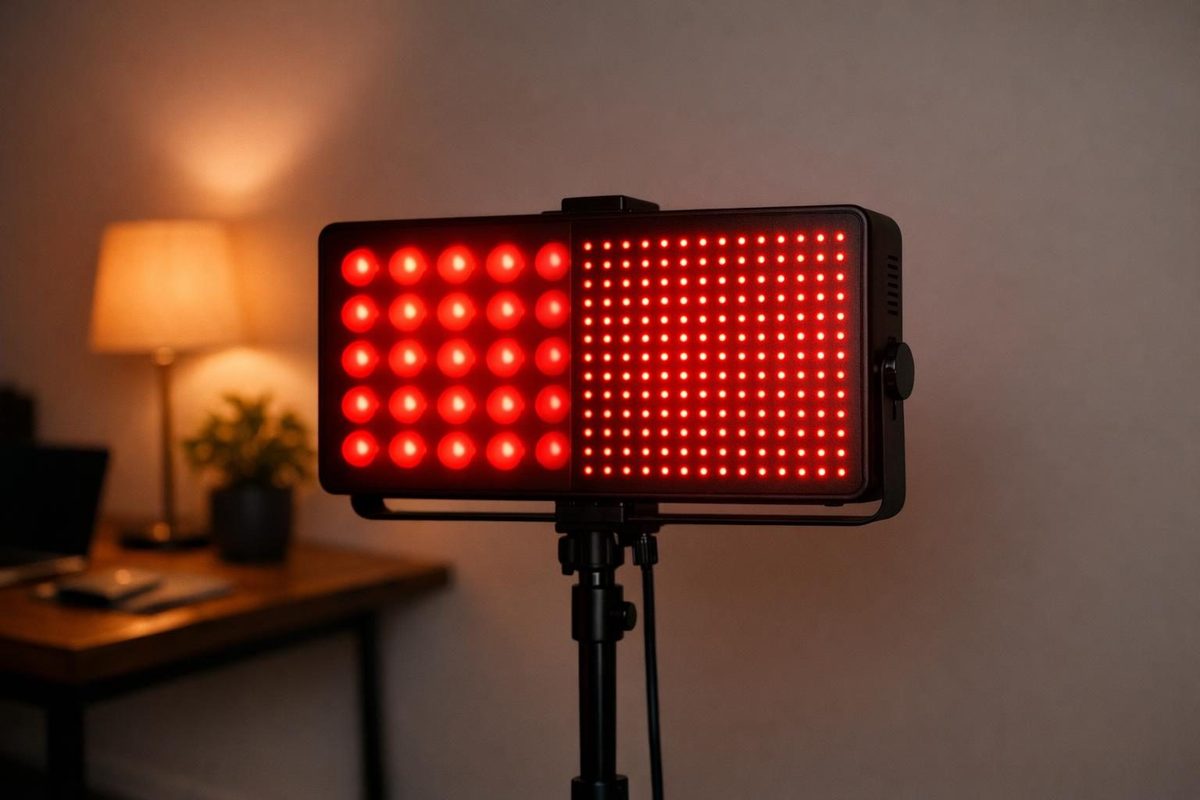
Pulsed red light therapy at 10 Hz and 40 Hz targets different biological responses, and picking the wrong setting can mean slower results or none at all. The first option flickers on and off ten times each second, while the second cycles at four times that speed. Both fall under photobiomodulation (PBM), the science of using LED or laser energy at a specific frequency to stimulate cellular repair in tissue. The difference comes down to which conditions respond best to each pulse frequency.
If you already own a red light therapy device with adjustable pulsing, this guide will help you dial in the right setting for your goals. Still shopping? Check our list of best red light therapy lamps that include pulsed options.
What Pulsed vs Continuous Red Light Therapy Actually Means
Continuous wave (CW) stays on at a constant intensity for the entire session. Pulsed light rapidly switches between on and off states at a set frequency, measured in hertz. A ten-cycle-per-second setting means the LED turns on and off rapidly. A forty-cycle setting repeats at four times that speed.
Why does this matter? Research on low-level laser therapy and LED therapy suggests that pulsing allows cells to absorb energy more efficiently compared to continuous delivery. During the off phase, cells experience a brief thermal relaxation period. This prevents heat buildup while still delivering therapeutic doses measured in J/cm2.
One thing most guides skip: the duty cycle matters just as much. A 50% duty cycle at the slower rate means the LED is on for 50 milliseconds and off for 50 milliseconds each cycle. Change it to 80%, and you get a very different dose even at the same rate. Most consumer panels default to a 50% duty cycle, but not all of them disclose this.
How 10 Hz Pulsing Affects Pain, Healing, and Inflammation
A ten-cycle-per-second pulse aligns with the alpha wave range of neural oscillation. This frequency has shown consistent results in studies focused on pain relief, wound recovery, and reducing swelling in muscle and joint areas.
Here is what the research points to:
- Pain management: Multiple studies on low-level laser therapy at this rate found greater pain reduction compared to continuous wave delivery in patients with joint and muscle injuries. Pulsed light may penetrate deeper into tissues because the off-cycle reduces surface heating, allowing more energy to reach the target tissue.
- Wound recovery and skin health: This setting appears to stimulate fibroblast activity and collagen production more effectively than higher rates for surface-level repair. It is a practical choice for skin rejuvenation and post-injury recovery.
- Inflammation: Pulsed exposure at this rate has been shown to reduce inflammation markers in animal models of chronic damage. The mechanism involves improved mitochondria function and increased adenosine triphosphate (ATP) production through activation of cytochrome c oxidase, the enzyme in the mitochondrial electron transport chain that absorbs photons in the 600 to 1100 nm range, spanning both visible and near-infrared (NIR) bands.
In my experience testing different LED devices, the slower pulse tends to produce a noticeable warmth reduction at the skin surface during sessions. That lower thermal load is one reason it may be better for reaching deeper tissue, especially when treating joints or dense muscle groups.
If you deal with red light therapy for rosacea or other inflammatory skin conditions, the slower setting may also reduce the risk of flare-ups from excess heat.
How 40 Hz Pulsing Targets Brain Health and Cognition
A forty-cycle pulse corresponds to gamma wave neural oscillation, the brain wave pattern linked to focus, memory consolidation, and higher-order cognition. This frequency is where pulsed photobiomodulation gets interesting for neurological applications.
Researchers at MIT published landmark work showing that gamma-rate stimulation (not specifically PBM wavelengths, but visible flicker) reduced amyloid plaques in mouse models of Alzheimer’s disease. The mechanism is called brainwave entrainment: external rhythmic stimuli can synchronize brain activity to match the stimulus. When the brain locks onto a gamma rhythm, it appears to activate microglia (the brain’s immune cells) to clear toxic protein buildup.
Key findings for gamma-range pulsing in photobiomodulation:
- Cognitive function: Early human trials suggest gamma-rate stimulation with sound may improve memory and attention in mild cognitive impairment patients. The signal transduction pathway involves gamma oscillation entrainment across cortical networks.
- Neuroprotection: This rate appears to boost the brain’s waste-clearing system (the glymphatic system), which operates more actively during synchronized gamma rhythms.
- Mental health and sleep: Some clinicians are exploring pulsed NIR at this rate for mood disorders and sleep regulation, though the research remains preliminary.
There is an important caveat. Most of the gamma-range research uses transcranial photobiomodulation with NIR (810 nm or 1064 nm) that can reach the human brain through the skull. Standard body-focused panels emitting 630 to 660 nm won’t penetrate to that depth. So if your goal is cognitive benefit, you need a device specifically designed for transcranial delivery at NIR bands with gamma pulsing capability.
One mistake I see repeatedly: people assume any panel aimed at the forehead will produce the same results as the clinical devices used in Alzheimer’s research. Those studies used precise energy dosing, specific spectral ranges, and controlled duty cycles. A general-purpose LED panel is not the same tool.
10 Hz vs 40 Hz: Side-by-Side Comparison
Choosing between these two pulsed rates depends entirely on what you are treating. Here is a direct comparison of how each performs across common outcomes.
| Factor | 10 Hz Pulsing | 40 Hz Pulsing |
|---|---|---|
| Primary target | Pain, swelling, wound recovery | Brain health, cognition, neuroprotection |
| Brain wave association | Alpha wave (8-12 cycles) | Gamma wave (30-100 cycles) |
| Best spectral pairing | 630-660 nm or 810-850 nm | 810-1064 nm for transcranial use |
| Penetration depth | Good for deeper body areas | Requires NIR to reach brain cells |
| Research maturity | Strong evidence for pain and healing | Growing evidence, mostly preclinical |
| Heat at skin surface | Lower thermal load | Moderate thermal load |
| Flicker sensitivity risk | Lower flicker perception | Higher visible flicker (may cause discomfort) |
| FDA-cleared devices | Several cleared for pain indications | Few cleared; most are investigational |
The FDA has cleared certain pulsed devices for pain management, but clearance for neurological applications remains limited. Always verify a product’s regulatory status before purchasing, especially for brain-related claims.
When to Use Each Pulse Setting (Decision Guide)
Not sure which frequency to choose? Use this decision logic based on your primary goal.
- Joint or muscle pain: Start with the slower pulse rate at 810-850 nm NIR. Apply for 10 to 20 minutes per area at a dose of 4 to 8 J/cm2. This combination has the strongest evidence for pain relief and lowering swelling in deeper areas.
- Skin or injury recovery: Use the same rate at 630-660 nm wavelength. Shorter sessions of 5 to 10 minutes work well for surface repair. The pulsed approach supports cellular regeneration without overheating the treatment area.
- Cognitive support or neuroprotection: Use the gamma rate with a transcranial NIR device at 810 nm or 1064 nm. Follow the manufacturer’s dosing protocol closely. This is not a standard panel application.
- General recovery and circulation: Either rate works, but the slower option is the safer default. It promotes blood flow through the circulatory system and supports overall healing without the flicker sensitivity concerns that come with quicker cycling.
If your device offers both options, there is no harm in alternating between sessions. Use the slower rate for body-focused recovery days and the faster one for transcranial sessions if your device supports it. The nature of pulsed delivery means you are adjusting how energy reaches cells, not the total dose (assuming equal duty cycles and session lengths).
Does Pulsed Delivery Actually Beat Continuous Wave?
This is the question behind the question. Before obsessing over specific rates, you should know whether any pulse frequency is actually better than continuous wave for your situation.
The honest answer: it depends on the condition. A 2019 systematic review of photobiomodulation studies found that pulsed light produced better therapeutic outcomes than CW in roughly 65% of the comparisons studied. The advantages were strongest for deeper tissue conditions and neurological applications. For superficial skin conditions, CW performed comparably to pulsing in most trials.
Pulsed light may offer advantages because:
- It reduces thermal buildup, allowing higher peak power without overheating
- The off-phase gives mitochondria time to complete the photochemical reaction cycle before the next burst of energy arrives
- Certain biological rhythms (like neural oscillation and cellular signaling cycles) respond to rhythmic stimulation at specific rates
CW still works. If your device does not have adjustable pulsing, you are not missing out entirely. CW vs pulsed matters most when treating conditions where depth of penetration or neural rhythm matters. For general skin health and hair growth applications, CW PBM results are well-documented.
That said, if you are comparing devices and considering red light therapy tanning beds, keep in mind that most tanning-bed-style units run CW only. Dedicated LED panels with adjustable pulse settings give you more control over your sessions.
Frequently Asked Questions About Pulsed PBM Therapy
Is 10 Hz or 40 Hz better for red light therapy?
Neither is universally better. The 10 Hz setting works best for pain relief, wound healing, and calming swelling in body areas. The 40 Hz option targets brain health through gamma brainwave entrainment and shows promise for cognitive conditions like Alzheimer’s disease. Pick the one that matches your treatment goal.
What does 10 Hz red light therapy do?
This setting means the LED pulses on and off ten times per second during a session. The rhythm aligns with alpha wave brain activity and has been shown to improve pain management, accelerate wound recovery, and reduce inflammation. It also allows deeper penetration by reducing heat buildup at the skin during treatment.
Can I use both 10 Hz and 40 Hz in the same session?
You can alternate between them, though most protocols keep one setting consistent per treatment area. Some advanced devices let you program sequential rates. Start each area with one option for the full recommended duration rather than switching mid-treatment. This gives cells a consistent rhythmic stimulus to respond to.
Do all red light therapy devices offer pulsing?
No. Many entry-level LED devices only produce steady output. Pulsing requires additional circuitry to rapidly switch the LEDs on and off at precise rates. If pulsing is important to you, verify the specifications before purchasing. Some products marketed as “pulsed” only offer a single fixed rate. Devices that are HSA/FSA eligible through the IRS medical expense guidelines may include this feature as standard, but confirm before buying.
Start by identifying your primary treatment goal, whether that is pain, skin, or brain health. Then set your red light therapy device to the matching pulse rate: 10 Hz for body-focused recovery or 40 Hz for transcranial cognitive support. If you are unsure, default to the slower setting for the broadest range of benefits and explore the faster option only with a purpose-built transcranial device using near-infrared output.