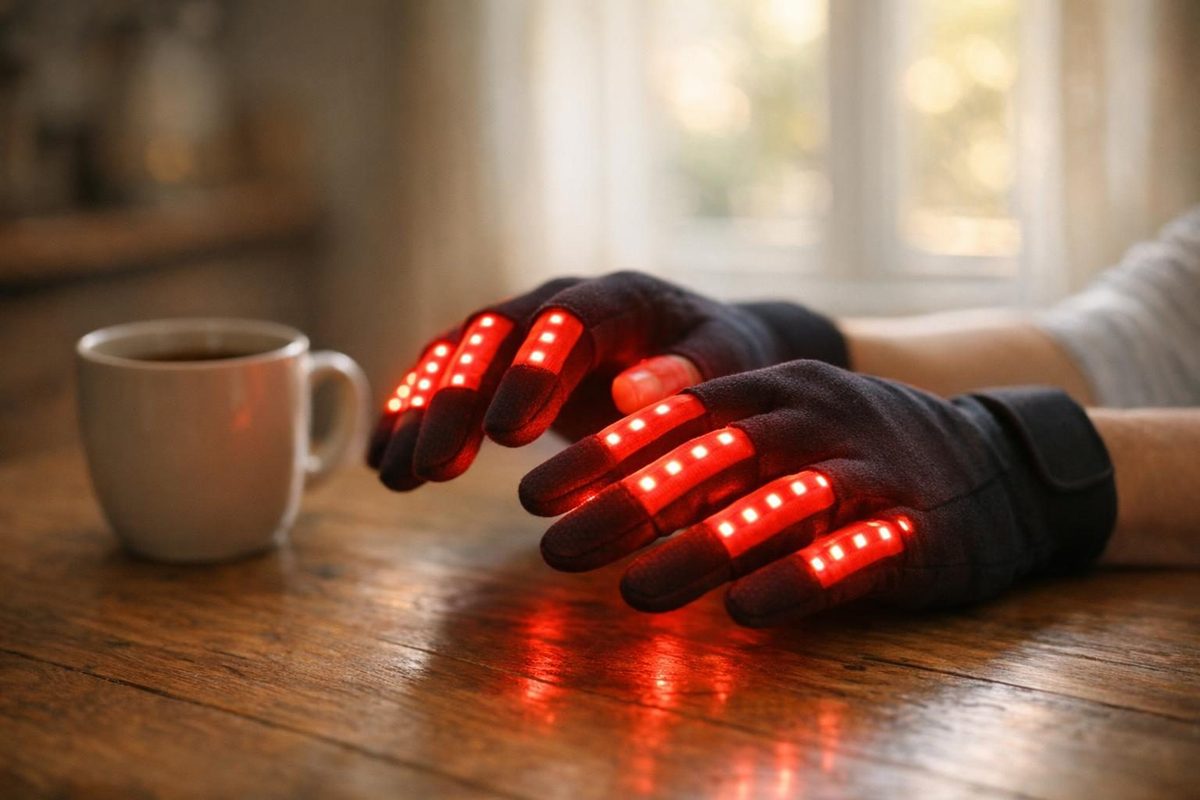
Red light therapy gloves for arthritis are wearable LED devices designed to deliver targeted photobiomodulation (PBM) directly to the joints of the hand. If you have stiff, aching fingers every morning, these gloves promise pain relief right where you need it. But do they actually relieve joint pain, or is this another wellness gadget collecting dust in a drawer?
About 58.5 million adults in the United States live with some form of arthritis, according to the CDC. Rheumatoid arthritis and osteoarthritis both hammer the small joints first. Grip weakens. Daily activities like opening jars or typing become painful. That is why a hands-free, at-home device that targets inflammation at the cellular level sounds so appealing.
How PBM Gloves Target Hand and Wrist Pain
These LED-equipped gloves work by positioning diodes against the skin of your fingers, knuckles, and wrist so photons penetrate into joint tissue. The mechanism is photobiomodulation: photons at 660nm and 880nm infrared are absorbed by cytochrome c oxidase, an enzyme inside mitochondria. This triggers increased ATP production, which fuels repair and reduces inflammatory markers.
Most models use between 50 and 150 LEDs spread across the palm and back of the hand. The open finger design allows your fingertips to remain free for gripping or tapping during treatment. Some units also include a wrist wrap section that extends coverage to the carpal tunnel area.
One thing most guides skip: the fit matters as much as the wavelength. A device that sits loosely lets photons scatter before reaching tissue. The amount of compression a well-fitted pair provides keeps the LEDs flush against skin, improving energy delivery measured in J/cm². Too loose and you lose penetration depth. Too tight and blood flow gets restricted, which works against the very healing process you are trying to support.
What Research Says About PBM for Arthritis Pain
A 2005 systematic review published in the Cochrane Database examined low-level laser therapy (a close relative of LED-based PBM) for rheumatoid arthritis. It found that patients with rheumatoid arthritis experienced reduced morning stiffness and less pain after 4 weeks of treatment. A separate MEDLINE-indexed study in 2019 looked at near-infrared (NIR) treatment on osteoarthritis in the hands and reported statistically significant pain reduction compared to placebo.
The evidence is encouraging but not bulletproof. Most studies used clinical laser devices, not consumer LED products. The energy output of a $40 pair from Amazon is nowhere near the J/cm² of a professional unit. That gap matters. Still, several smaller trials using LED arrays at therapeutic doses showed measurable reductions in swelling and joint stiffness over 8 to 12 weeks of consistent use.
Physical therapy researchers at Sao Paulo University found that PBM at specific doses helped stimulate cartilage cell activity in osteoarthritis patients. The physiotherapy community now treats photobiomodulation as a legitimate adjunct, not a replacement, for conventional arthritis management including exercise and medication.
Top-Rated PBM Gloves for Arthritis in 2026
Not every product on the market is worth the money. Here are the features and models that stand out based on LED count, accuracy, and build quality.
| Feature | Budget ($30-$50) | Mid-Range ($50-$100) | Premium / FDA-Cleared ($100+) |
|---|---|---|---|
| LED Count | 50-80 | 80-120 | 120-150+ |
| Output | 660nm only | 660nm + 880nm dual | Dual spectrum + pulsed modes |
| Modes | 1-2 | 3 | 5 modes (continuous, pulsed, heat) |
| Coverage | Minimal | Partial wrist wrap | Full hand coverage |
| Design | Basic, open finger | Breathable, flex mitt | Cordless infrared, adjustable |
| Classified as Medical Devices | No | Rarely | Some FDA-cleared |
The FDA has cleared a small number of infrared light therapy devices for temporary relief of minor muscle and joint pain. Products classified as medical devices must meet stricter manufacturing standards. Look for the FDA 510(k) clearance number on the product listing if a brand claims clearance.
Premium models with 5 modes typically offer continuous output, combined dual spectrum, pulsed mode, and a heating pad function. The pulsed setting is worth exploring because pulsed red light therapy frequencies may affect the body differently than continuous wave output. A flex mitt design with breathable fabric prevents sweat buildup during the 15 to 20 minute treatment sessions.
If you already own a panel or lamp, you can position your hands in front of it instead. Check our list of the best phototherapy lamps for home use for options that treat hands, face, and full body.
How to Use Your PBM Gloves for the Best Results
Consistency beats intensity. Here is a straightforward protocol based on published dosimetry guidelines and user reports.
- Start with clean, dry hands. Remove rings and lotions. Oils on the skin can reflect photons and reduce penetration into the joint.
- Put on the device snugly. The LEDs should press gently against your skin. If adjustable straps or a wrist wrap are included, tighten until comfortable without restricting circulation.
- Set the mode. Begin with the continuous setting for the first week, then switch to a combined 880nm infrared setting. The deeper reach of NIR helps target joint tissue that surface-level output alone cannot.
- Treat for 15 to 20 minutes per session. Most manufacturers recommend this window to deliver roughly 4 to 8 J/cm² per session. Longer is not better; exceeding the dose can trigger a biphasic response where benefits plateau or reverse.
- Repeat daily. Studies showing positive outcomes in RA and OA patients used daily sessions for a minimum of 4 weeks. Skipping days resets the cumulative benefit.
After about 2 to 3 weeks of daily use, many people notice less morning stiffness and improved grip strength. Full results for reducing pain typically take 6 to 8 weeks. Keep a simple log: rate your discomfort and mobility from 1 to 10 each morning before treatment. That data helps you decide if the device is working or if you need to adjust your approach.
Compression Gloves vs. Photobiomodulation Gloves: Which Helps More?
Standard compression gloves for arthritis apply gentle pressure to swollen hands, which can relieve edema and support weak joints. They are inexpensive, usually $10 to $20, and work passively all day. Copper-infused versions have been marketed heavily, though evidence for copper itself easing discomfort is thin.
PBM-equipped devices do something compression alone cannot: they stimulate energy production at the tissue level and help reduce inflammatory cytokines. Think of compression as mechanical support and photobiomodulation as a biochemical intervention. They address different layers of the problem.
The smartest approach combines both. Wear compression gloves during the day for joint support during daily activities. Use your therapy device for a dedicated 15 to 20 minute session in the evening to accelerate recovery and soothe inflamed tissue. Some premium models already provide a mild amount of compression by design, giving you both benefits in one package.
People dealing with photobiomodulation for skin conditions like rosacea already know that these photon-based treatments reduce swelling systemically. The same anti-inflammatory mechanism that calms irritated skin also helps calm arthritic joints.
Are These Devices Covered by Insurance?
Most health insurance plans do not cover consumer LED devices. However, if your product is FDA-cleared and classified as a medical device, you may be able to purchase it using HSA/FSA funds. The IRS allows HSA and FSA spending on devices prescribed or recommended by a healthcare provider for a diagnosed condition.
Get a letter of medical necessity from your doctor that specifies your arthritis diagnosis and the prescribed use of a photobiomodulation device. Keep the receipt showing the product name and FDA clearance status. Not every flexible spending administrator will approve it on the first try, but having documentation makes a denial easier to appeal.
What to Watch Out for When Buying
Cheap products sometimes list specs they do not actually deliver. A device claiming 660nm and 880nm output should provide third-party test data or at minimum a spectral graph. Without verification, you might be wearing a $35 LED hand warmer with no therapeutic accuracy.
Battery life matters for cordless infrared models. If the battery dies 10 minutes into a 20 minute session, you are getting half the intended dose. Look for units rated at 30+ minutes per charge.
Avoid products with no user guide or dosage recommendations. A responsible manufacturer includes a protocol: session duration, recommended frequency, and contraindications. If the listing is all marketing language and no specs, move on.
Actionable Next Steps for Arthritis Hand Pain
Start by choosing a device with verified 660nm and 880nm LEDs, at least 80 LEDs total, and a snug fit around your hand. Commit to daily 15 to 20 minute sessions for 6 weeks before judging results. Track your pain, stiffness, and mobility each morning so you have objective data. If your arthritic joints respond well, consider pairing the device with gentle hand exercises recommended by a physiotherapy professional to build on the gains. Red light therapy gloves for arthritis are not a cure, but for many people they provide a meaningful, drug-free path to relieve pain and reclaim function in their hands.
Frequently Asked Questions
Is red light therapy good for arthritic hands?
PBM at 660nm and near-infrared at 880nm has shown positive results for reducing joint pain and morning stiffness in arthritic hands. Multiple studies on patients with rheumatoid arthritis and osteoarthritis report measurable improvements after 4 to 8 weeks of daily use. It works best as a complement to exercise and medical treatment, not as a standalone cure.
Do red light gloves really work?
LED-based therapy devices can deliver therapeutic doses to hand joints when built with accurate LEDs and proper energy output. Clinical evidence supports photobiomodulation for pain relief and reducing inflammation. The catch is quality: budget products with inaccurate specs or too few LEDs may not deliver a therapeutic dose, so device selection matters significantly.
What is the FDA approved red light therapy glove?
The FDA does not “approve” consumer LED products in the same way it approves drugs. Instead, certain devices receive FDA 510(k) clearance, which means they are classified as medical devices authorized to provide temporary relief of minor pain and stiffness. Check for a valid 510(k) clearance number on any product claiming FDA status.
How long does it take for red light therapy to work for arthritis?
Most users notice initial improvements in stiffness and discomfort within 2 to 3 weeks of daily 15 to 20 minute sessions. Significant, sustained pain relief typically requires 6 to 8 weeks of consistent use. Skipping sessions delays results because photobiomodulation benefits are cumulative, building on repeated stimulation over time.